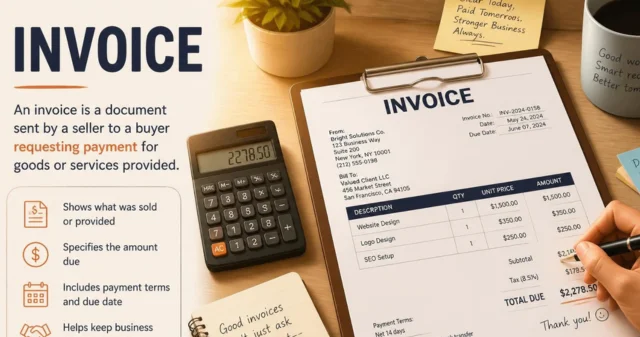
The invoice definition is simple: it is a formal request for payment that records goods or services supplied. Businesses use invoices to show what a customer owes, when payment is due, and how to pay. For U.S. businesses, clear billing records also support bookkeeping, customer communication, and tax documentation.
An invoice is a seller’s itemized request for payment after supplying goods or services. It identifies the parties, charges, total due, payment terms, and due date. Businesses also use invoices to track sales, receivables, customer balances, and supporting records.
| Key fact | What it means |
| Main purpose | Request payment and document a sale |
| Typical sender | Seller, service provider, freelancer, or vendor |
| Typical recipient | Customer, client, or buyer |
| Common timing | Often after goods ship or services are completed |
| Payment status | Usually shows an amount still due |
| Business use | Billing, bookkeeping, receivables, and recordkeeping |
TL;DR: Invoices request payment, while receipts usually confirm payment. Good versions identify the parties, charges, due date, and payment terms. U.S. businesses should also keep supporting records that fit their bookkeeping and tax needs.
Invoice Definition: What Does It Mean?
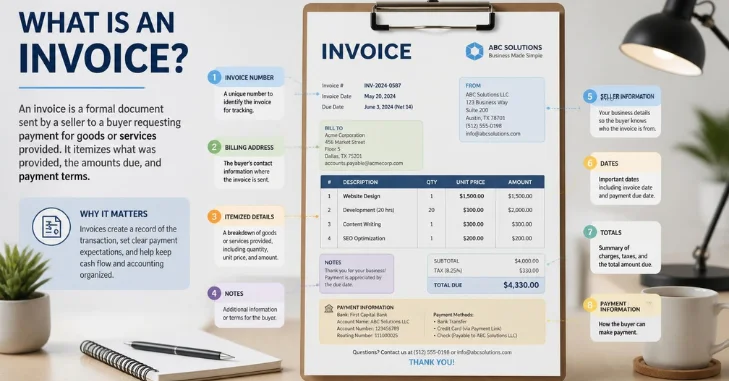
An invoice definition creates a written record of a sale and tells the buyer what amount remains due. It normally appears after a seller provides goods or completes agreed work. The document can be paper-based, emailed as a PDF, or created inside accounting software.
From the seller’s view, the document supports accounts receivable and payment follow-up. From the buyer’s view, it supports accounts payable and approval workflows. It does not, by itself, prove that payment already occurred.
What Information Should Invoices Include?
Good invoices answer four questions quickly: who is billing, what was supplied, how much is due, and when. They should also make payment instructions easy to find. Specific fields can vary by industry, customer requirements, and applicable state or local rules.
- Seller name, business details, and contact information
- Buyer or customer billing details
- A unique invoice number
- Issue date and payment due date
- Clear descriptions of goods or services
- Quantities, hours, rates, or unit prices when relevant
- Subtotal, discounts, applicable tax, and total due
- Payment terms, accepted methods, and payment instructions
- Purchase order or project reference when required
Use exact service dates, quantities, rates, and descriptions when they help the customer verify a charge. A vague line such as “consulting services” can slow approval. A clearer description, such as “September website maintenance, 10 hours,” gives the buyer useful context.
How Invoicing Works in Practice
Most invoicing begins after the parties agree on the work, price, and payment terms. The seller completes the work or ships the goods, then sends the billing document. The buyer reviews it, resolves questions, and pays by the stated deadline.
After payment arrives, the seller records the payment and updates the balance. A receipt or paid status can then confirm that the amount was settled. This sequence keeps the payment request separate from proof of payment.
Why Businesses Use Invoices
Clear billing records help businesses organize revenue, follow unpaid balances, and reconcile customer accounts. They also help teams connect each sale with contracts, purchase orders, or delivery records. Marketinic’s accounting services guide explains how bookkeeping and financial reporting fit together.
The IRS lists invoices among supporting documents for sales, purchases, expenses, and certain asset records. Those records can support entries in business books and items reported on tax returns. Record-retention periods depend on the event, expense, and tax rule involved.
Billing Documents vs Bills, Receipts, and Quotes
| Document | Main purpose | Typical timing | What it usually shows |
| Invoice | Requests payment | After delivery, before payment | Items, charges, terms, due date |
| Bill | Requests payment | Often at purchase or soon after | Amount owed, often due sooner |
| Receipt | Confirms payment | After payment | Amount paid, date, payment method |
| Quote | Proposes a price | Before work or sale | Expected scope, price, and conditions |
In everyday U.S. usage, “bill” and “invoice” can overlap, so context matters. Businesses often use invoices for payment due later, while bills can imply immediate payment. A receipt is different because it confirms that money was received.
Quotes also serve a different stage of the transaction. They describe proposed prices before the sale or work is finalized. Once the parties proceed, the later billing document records the amount due.
A Simple Billing Example
| Field | Example |
| Seller | Blue Harbor Design LLC |
| Customer | Northside Coffee |
| Document number | BH-1042 |
| Issue date | September 1, 2026 |
| Due date | September 30, 2026 |
| Description | Logo refresh and final brand files |
| Subtotal | $1,250 |
| Tax | Apply if required by the relevant jurisdiction |
| Payment terms | Net 30 |
| Payment method | ACH or card, based on agreed instructions |
This example gives the customer enough information to identify the work and deadline. A unique reference number makes follow-up and reconciliation easier. If taxes apply, show them separately and follow the rules for the relevant jurisdiction.
Common Billing Types and Payment Terms
| Billing type | When it is useful |
| Standard | A one-time completed sale or service |
| Recurring | Repeated services, retainers, or subscriptions |
| Pro forma | A preliminary document before a final charge |
| Interim | Partial billing during a longer project |
| Credit memo | Reduces or reverses part of an earlier charge |
Mistakes That Can Delay Payment
Payment delays often start with small errors rather than complex accounting problems. Wrong customer details, missing purchase-order references, vague descriptions, and incorrect totals can stop approval. Before sending, verify names, dates, rates, tax treatment, and payment instructions.
Automated billing tools can reduce repetitive data entry and schedule reminders for overdue balances. They still need accurate customer and transaction data. Marketinic’s guide to modern business accounting systems covers related tools for invoicing, expense tracking, and connected financial systems.
What to Do Next
Good billing starts with a clear process, not a complicated template. Set consistent numbering, accurate customer details, specific line items, clear terms, and a review step before sending. Business buyers should also review receivables and payables during due diligence.
Marketinic’s buying a business guide explains the broader financial review. Use the checklist above before sending your next billing document. Keep supporting records with your bookkeeping files and update payment status promptly.
Frequently Asked Questions
What is an invoice, in simple terms?
It means an itemized request for payment from a seller to a buyer. It states what was provided, what the customer owes, and when payment is due. It also creates a useful business record for both parties.
Is a billing document the same as a receipt?
No, the two documents serve different stages of payment. A billing document requests payment, while a receipt confirms payment has already occurred. Both may describe the same transaction.
Does receiving one mean I already paid?
No, receiving one usually means you’re being asked to pay or that the transaction is being documented. Check the document for a due date, balance, and any paid status. Use a receipt or payment record when you need proof that money moved.
What does an invoice number mean?
It is a unique reference assigned to a billing document. Businesses use that reference to track, search, reconcile, and discuss specific transactions. Customers may also use it as a payment reference.