
External links can make content more useful by pointing readers to credible, relevant sources. They support verification, provide context, and help readers make informed decisions. Used carelessly, they can create trust problems, broken journeys, or policy risks.
Direct answer: Outbound references connect your page to a different domain and help readers verify claims. Use them when a source adds evidence, context, or a useful next step. Google recommends linking out when it makes sense, while descriptive anchor text helps readers understand the destination.
| Key question | Practical answer |
| What is an outbound link? | A hyperlink from your website to another domain. |
| Does Google recommend citing other sites? | Yes, when the destination helps readers or supports a claim. |
| Do normal editorial citations need nofollow? | No. Trusted editorial citations usually need no special rel value. |
| What should paid placements use? | Google recommends rel= “sponsored” for advertisements and compensated placements. |
| What should user-generated content use? | rel= “ug” is designed for comments, forums, and similar content. |
| Is there an ideal quantity? | Google provides no fixed number. Use only destinations that improve the page. |
| What matters most? | Relevance, source quality, descriptive anchor text, and regular maintenance. |
| What about U.S. affiliate content? | Compensation may also require clear disclosure under FTC guidance. |
Key Takeaways
- Cite primary or authoritative sources when they strengthen a claim.
- Use normal editorial hyperlinks without adding nofollow by default.
- Mark compensated placements with the appropriate sponsored attribute.
- Review destinations periodically because useful pages can move, expire, or change.
- Choose descriptive anchor text instead of vague wording such as “click here.”
What Counts as an Outbound Link?
An outbound link sends a visitor from your domain to a different website. It might point to research, documentation, statistics, or another useful resource. This differs from internal linking, which keeps visitors within your own domain.
The terminology can become confusing because backlinks also cross domains. A backlink points from somebody else’s website toward yours. An outbound citation points from your page toward theirs.
That distinction matters when discussing SEO strategy. You directly control the references placed on your own pages. You have much less control over editorial backlinks earned from other publishers.
Why External Links Matter for SEO
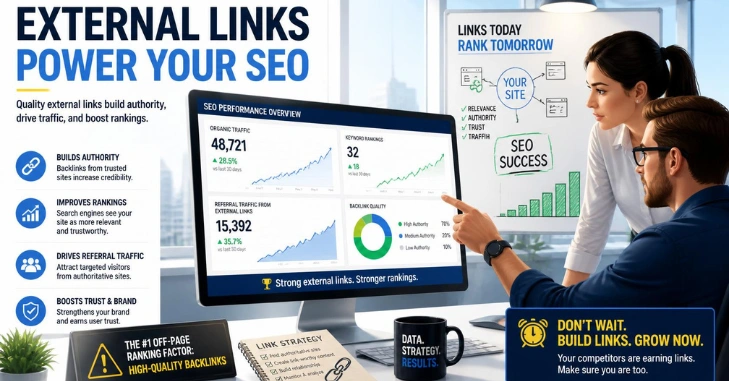
External Links are useful when they help readers access reliable sources or verify information. Google explicitly says publishers should not be afraid to link to other websites. A useful citation can establish trustworthiness by letting readers verify information. It can also give readers context that your page cannot efficiently provide.
That does not mean adding random citations will automatically increase rankings. Google does not publish a rule promising higher positions for pages with outbound references. The strongest reason to add one is reader usefulness.
Good sourcing can also improve editorial credibility. A statistic is stronger when readers can inspect its source. Technical advice becomes easier to trust when documentation supports the recommendation.
This approach fits within a broader search strategy rather than replacing it. Marketinic’s guide to cost-effective SEO strategies covers content, keywords, technical work, and authority building. Outbound citations should support those efforts rather than become a separate ranking trick.
Choose the Correct Link Attribute
Not every outbound citation should be treated the same. Google provides several rel values for explaining a publisher’s relationship with a destination. Choosing the correct value is more useful than automatically applying nofollow everywhere.
| Situation | Recommended treatment | Why |
| Trusted editorial citation | No special rel attribute | It is a normal editorial reference |
| Advertisement or paid placement | rel= “sponsored” | Identifies compensation |
| Forum or comment submission | rel= “ug” | Identifies user-generated content |
| Source you do not want associated with your site | rel= “nofollow” | Signals limited endorsement |
| Affiliate placement | Usually sponsored | Compensation affects the relationship |
Google says sponsored is preferred for advertisements and paid placements. It also still accepts nofollow in those situations. Google treats these attributes as signals when processing web relationships.
U.S. publishers also need to consider consumer disclosure requirements. SEO markup does not replace a clear disclosure of a material relationship. FTC guidance says affiliate compensation should be disclosed clearly and conspicuously near relevant recommendations.
That distinction matters most for review sites. The sponsored attribute communicates the relationship to Google. A visible disclosure communicates that relationship to the reader.
How Many Outbound References Should a Page Have?
No universal number applies to every article. Google specifically says there is no magical ideal quantity of hyperlinks on a page. The appropriate amount depends on usefulness and context.
A short definition may need only one authoritative source. A research-heavy article can reasonably cite many original studies or documents. Removing useful citations merely to meet an arbitrary ratio can make content less helpful.
Search Engine Land gives similar practical guidance. It recommends focusing on whether each destination improves clarity, credibility, or usefulness. Page length and reader intent should guide the decision.
The best test is simple. Ask whether the reader gains something meaningful by following the citation. If the answer is unclear, the reference probably does not need to exist.
How to Choose Sources Worth Citing
Start with the source whenever one exists. Government agencies, research organizations, official documentation, and primary company announcements often provide stronger evidence. Secondary commentary can still help when it adds expert analysis.
Freshness also deserves attention. Statistics and technical instructions can become outdated quickly. Check publication dates and current documentation before using a source to support an important claim.
Relevance matters as much as authority. A famous domain is not automatically the right source for every subject. The destination should directly support the surrounding sentence or provide useful additional context.
| Source check | What to look for |
| Relevance | Direct connection with the claim being supported |
| Authority | Expertise or first-party knowledge of the subject |
| Freshness | Current information when the topic changes over time |
| Transparency | Clear publisher, author, or organization |
| Stability | A dependable page that is unlikely to disappear quickly |
For technical website topics, sourcing works best alongside sound site architecture. Marketinic’s technical SEO guide for small businesses explains crawlability, indexing, site structure, and broken-page maintenance. Those foundations help search engines process your content reliably.
Write Descriptive Anchor Text
Anchor text should tell readers what they will find after clicking. Google recommends wording that is descriptive, concise, and relevant to the destination. Generic anchors provide less context for both users and search systems.
For example, “Google’s outbound-link qualification guidance” clearly explains the destination. “Click here” gives readers almost no useful information. The surrounding sentence should also explain why the destination matters.
Avoid stuffing commercial keywords into every anchor. Natural wording usually provides enough context. Variation also makes editorial content read more naturally.
Avoid Common Outbound-Linking Mistakes
One common mistake is automatically adding nofollow to every outside citation. Google specifically advises against treating every destination that way. Trusted editorial references normally need no special qualification.
Another problem is citing weak sources merely because they rank well. Ranking position does not guarantee that a page is the original authority. Trace statistics, research findings, and official policies back to their primary source.
Broken destinations also create unnecessary friction for readers. Pages disappear, domains change ownership, and old resources may become irrelevant. Review important citations during routine content updates.
Marketinic already covers broader channel planning in its digital marketing fundamentals guide. That wider perspective matters because SEO works alongside content, paid media, social channels, and website experience. Citation strategy should support useful content, not distract from it.
Build an Outbound-Link Review Into Publishing
Writers should verify every destination before publishing. Open the page and confirm that it supports the claim beside the anchor. Check whether a more authoritative primary source exists.
Editors should also inspect the commercial relationship. Paid placements need appropriate qualification, while affiliate recommendations may require visible disclosures. User-submitted destinations may need ugc or nofollow treatment.
Finally, schedule citation checks during major content updates. Replace dead resources and update outdated research where necessary. This small maintenance habit protects both usability and editorial credibility.
Make Every Citation Earn Its Place
A strong citation gives readers evidence, context, or a useful resource they could not get from your page alone. Good source selection also shows that your content was researched rather than assembled from unsupported claims. Regular checks keep those references useful as the web changes.
Start by reviewing your highest-traffic pages and checking every outbound destination. Replace weak sources with original documentation where possible. Then apply the correct attributes and disclosures before your next content update.
Frequently Asked Questions
Are External Links Good for SEO?
They can support SEO when they make a page more useful and trustworthy. Google encourages publishers to cite other websites when doing so helps readers. No published guarantee exists that adding outbound citations alone raises rankings.
Should Every Outbound Reference Use Nofollow?
No, trusted editorial citations usually do not require nofollow. Google recommends that qualification when you don’t want a normal association with a destination. Paid placements should generally use the sponsored value instead.
Can Linking to Another Website Hurt My Rankings?
Normal editorial citation is not something Google tells publishers to avoid. Problems can arise from manipulative schemes, paid placements without proper qualification, or irrelevant destinations. Focus on reader value and transparent commercial relationships.
How Many Outbound Citations Should a Blog Post Have?
There is no fixed SEO formula for the correct quantity. A page should contain as many useful references as its claims and subject require. Remove citations that add no evidence, context, or meaningful next step.
What Is the Difference Between an Outbound Link and a Backlink?
An outbound hyperlink goes from your website to another domain. A backlink starts on another website and points toward yours. Both cross domains, but they serve different roles in your SEO strategy.