
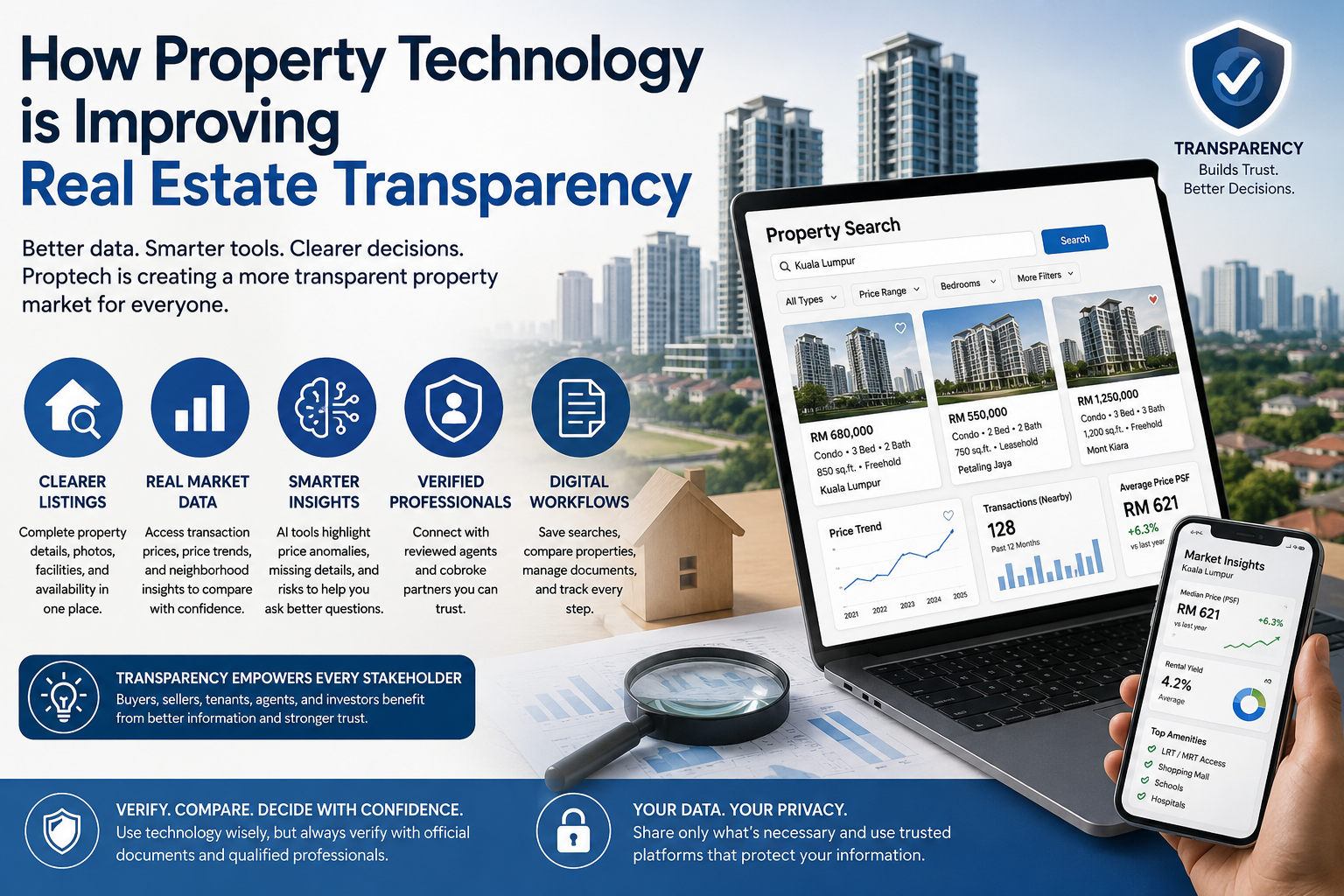
Property decisions often begin with a frustrating gap: unclear prices, hidden costs, outdated listings, and claims that are hard to verify. property technology Malaysia is helping close that gap by putting better property information within reach.
For buyers, sellers, tenants, and agents, property technology Malaysia means faster research and clearer comparisons. Used with care, Property technology in Malaysia can improve trust, but it doesn’t replace legal, financial, valuation, or tax advice.
The strongest decisions still combine useful data with careful human judgment.
How Property Technology Malaysia Improves Real Estate Transparency
Real estate transparency means people can access, compare, and check the information behind a property decision. That includes listing details, pricing evidence, agent identity, transaction history, rental context, and relevant documents.
Proptech improves how this information moves between buyers, sellers, tenants, agents, developers, and investors. Instead of relying on one conversation or one advertised price, users can build a more complete picture before taking the next step.
Property Listings Become Easier to Compare and Verify
A good property search platform gives users more than a headline price. It organizes location, property type, size, tenure, photos, facilities, rental terms, and agent contact details into a format people can compare.
Status updates also matter. A listing marked available when it was rented months ago wastes time and weakens trust. Structured fields can reduce vague descriptions, missing information, and repeated listings for the same unit.
Still, a polished listing isn’t proof. Buyers should confirm the actual condition, built-up area, ownership restrictions, and availability before making an offer.
A listing is a starting point for due diligence, not the due diligence itself.
Real Transaction Data Brings More Clarity to Property Prices
An asking price is a seller’s expectation. A completed transaction price shows what a buyer paid. That distinction can change a negotiation.
Sub-sale data platforms such as Brickz.my have helped make Malaysian transaction records easier to review. Users can assess median prices, price per square foot, historical movement, and nearby sales before deciding whether an asking price looks reasonable.
Market data becomes more useful when it is compared by property type, location, age, size, and tenure. A luxury high-rise and a landed home in the same postcode may follow very different pricing patterns.
Digital Records and AI Help People Review Deals Faster
Analytics tools can flag unusual prices, missing listing details, or gaps between an advertised unit and nearby market evidence. Digital workflows also make it easier to organize viewing notes, documents, agent conversations, and deal comparisons.
AI-assisted reviews can support faster research by highlighting questions worth asking. Is the price far above recent comparables? Does the listing provide enough information? Are important terms missing?
AI can support a decision, but it can’t issue a formal valuation or replace qualified legal, tax, financial, or property advice.
Why Property Technology Malaysia Matters to Buyers, Sellers, and Agents
Malaysia’s property market has a growing mix of listing portals, transaction platforms, market-data services, and property-management tools. Better information supports better decisions, especially when prices and local conditions vary sharply between areas.
JLL’s Global Real Estate Transparency Index also shows that data quality, market rules, and digital services are closely tied to stronger real estate transparency.
Buyers and Tenants Can Make Better Shortlists
Instead of viewing every available unit, buyers and tenants can filter by location, budget, property type, size, tenure, rental terms, and nearby amenities. That creates a more focused shortlist.
Before committing, compare several sources. Review available transaction evidence, ask about estimated costs, and confirm key details through official records or qualified professionals. This is especially important before signing a tenancy agreement, sale and purchase agreement, or financing documents.
Sellers and Agents Gain More Trust Through Better Profiles
Clear professional profiles can improve accountability. Buyers can review an agent’s service area, listings, response history, referrals, and cobroke activity before starting a conversation.
Complete listing information also makes agents more credible. Accurate pricing, clear photos, and direct answers create confidence long before a viewing.
A platform profile alone does not prove licensing, performance, or authority to act. Clients should verify credentials through the proper Malaysian channels before appointing an agent.
Developers and Investors Can Read Market Signals More Clearly
Aggregated data can help developers and investors assess demand, price movement, rental conditions, and location trends. That is useful when planning a project, reviewing an acquisition, or comparing potential returns.
But data needs context. A small sample, older sales records, unusual unit sizes, or a rapidly changing neighborhood can distort the picture. Numbers are evidence, not a final verdict.
PropPlace Shows What Transparent Property Technology Can Look Like
PropPlace.my brings public property search, reviewed agent profiles, cobroke requests, market context, analytics, export tools, marketplace workflows, and AI-assisted deal reviews into one Malaysian platform.
This structure reduces the need to jump between disconnected sources. PropPlace identifies itself as a technology and marketplace platform, not an official valuer, lawyer, financial adviser, tax adviser, or investment adviser.
One Platform Can Connect Search with Market Context
A buyer can move beyond browsing and ask better questions. Does an asking price fit nearby trends? Is the tenure clear? Does the listing include enough detail to justify a viewing or a deeper review?
For agents, shared workflows and cobroke requests can also make collaboration more visible. Better records create a clearer path from inquiry to viewing and negotiation.
Transparency Still Depends on Accurate Data and User Checks
Platform data, user-submitted details, AI outputs, and agent information all need confirmation. Users should check title details, approvals, property condition, ownership, outstanding charges, financing terms, and contract documents with the right professionals.
Technology improves access to information. It cannot guarantee that every submitted detail is complete or current.
The Limits and Risks of Digital Real Estate Transparency
More data does not automatically mean better decisions. Outdated records, misleading user content, incomplete databases, and biased algorithms can create false confidence.
JLL’s transparency research also links stronger markets with progress in data and digital services. That progress must include responsible data practices, not only more features.
Protect Personal Data During Property Transactions
Property searches, rentals, financing, and sales can involve identity documents, income records, bank information, and signed agreements. Share only what is necessary, use secure communication channels, and read the platform’s privacy policy.
Users should understand how personal data is stored, processed, and shared before uploading sensitive documents.
Use Proptech as a Research Tool, Not a Final Answer
Compare several listings, review market evidence, and question claims that look unusual. Confirm critical information through official sources and seek licensed legal, valuation, tax, or financial advice when the decision requires it.
Transparency reduces blind spots. It does not remove every property risk.
Final Thoughts
Property technology makes real estate information easier to search, compare, and assess. Transaction data, professional discovery, analytics, digital workflows, and AI-assisted research can all reduce the uncertainty that slows property decisions.
In Malaysia, platforms such as PropPlace show how organized information can support more confident research. The most transparent property decisions still pair technology with independent checks and qualified professional advice.